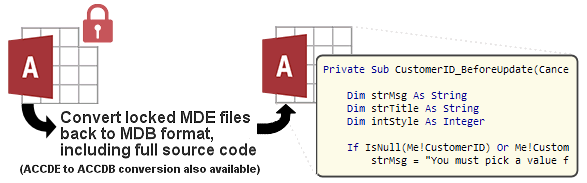
IN THE SPOTLIGHT: MDE to MDB Conversion Service
(also supports: ACCDE to ACCDB, ADE to ADP, etc)
IN THE SPOTLIGHT: Access Database Repair Service
An in-depth repair service for corrupt Microsoft Access files

IN THE SPOTLIGHT: vbWatchdog
VBA error handling just got easier...

" vbWatchdog is off the chart. It solves a long standing problem of how to consolidate error handling into one global location and avoid repetitious code within applications. "
- Joe Anderson,
Microsoft Access MVP
Meet Shady, the vbWatchdog mascot watching over your VBA code →
(courtesy of Crystal Long, Microsoft Access MVP)
IN THE SPOTLIGHT: vbMAPI
An Outlook / MAPI code library for VBA, .NET and C# projects
Get emails out to your customers reliably, and without hassle, every single time.

Use vbMAPI alongside Microsoft Outlook to add professional emailing capabilities to your projects.
IN THE SPOTLIGHT: Code Protector
Standard compilation to MDE/ACCDE format is flawed and reversible.
Provided by Allen Browne, allenbrowne.com, June 1997. Updated October 2004.
Every function or sub should contain error handling. Without it, a user may be left viewing the faulty code in a full version of Access, while a run-time version just crashes.
The simplest approach is to display the Access error message and quit the procedure. Each procedure, then, will have this format (without the line numbers):
1 Sub|Function SomeName()
2     On Error GoTo Err_SomeName          ' Initialize error handling.
3     ' Code to do something here.
4 Exit_SomeName:                          ' Label to resume after error.
5     Exit Sub|Function                   ' Exit before error handler.
6 Err_SomeName:                           ' Label to jump to on error.
7     MsgBox Err.Number & Err.Description ' Place error handling here.
8     Resume Exit_SomeName                ' Pick up again and quit.
9 End Sub|Function
For a task where several things could go wrong, lines 7~8 will be replaced with more detail:
      Select Case Err.Number
      Case 9999                        ' Whatever number you anticipate.
          Resume Next                  ' Use this to just ignore the line.
      Case 999
          Resume Exit_SomeName         ' Use this to give up on the proc.
      Case Else                        ' Any unexpected error.
          Call LogError(Err.Number, Err.Description, "SomeName()")
          Resume Exit_SomeName
      End Select
The Case Else in this example calls a custom function to write the error details to a table. This allows you to review the details after the error has been cleared. The table might be named "tLogError" and consist of:
Field Name Data Type Description ErrorLogID AutoNumber Primary Key. ErrNumber Number Long Integer. The Access-generated error number. ErrDescription Text Size=255. The Access-generated error message. ErrDate Date/Time System Date and Time of error. Default: =Now() CallingProc Text Name of procedure that called LogError() UserName Text Name of User. ShowUser Yes/No Whether error data was displayed in MsgBox Parameters Text 255. Optional. Any parameters you wish to record.
Below is a procedure for writing to this table. It optionally allows recording the value of any variables/parameters at the time the error occurred. You can also opt to suppress the display of information about the error.
Function LogError(ByVal lngErrNumber As Long, ByVal strErrDescription As String, _
    strCallingProc As String, Optional vParameters, Optional bShowUser As Boolean = True) As Boolean
On Error GoTo Err_LogError
    ' Purpose: Generic error handler.
    ' Logs errors to table "tLogError".
    ' Arguments: lngErrNumber - value of Err.Number
    ' strErrDescription - value of Err.Description
    ' strCallingProc - name of sub|function that generated the error.
    ' vParameters - optional string: List of parameters to record.
    ' bShowUser - optional boolean: If False, suppresses display.
    ' Author: Allen Browne

    Dim strMsg As String      ' String for display in MsgBox
    Dim rst As DAO.Recordset  ' The tLogError table

    Select Case lngErrNumber
    Case 0
        Debug.Print strCallingProc & " called error 0."
    Case 2501                ' Cancelled
        'Do nothing.
    Case 3314, 2101, 2115    ' Can't save.
        If bShowUser Then
            strMsg = "Record cannot be saved at this time." & vbCrLf & _
                "Complete the entry, or press <Esc> to undo."
            MsgBox strMsg, vbExclamation, strCallingProc
        End If
    Case Else
        If bShowUser Then
            strMsg = "Error " & lngErrNumber & ": " & strErrDescription
            MsgBox strMsg, vbExclamation, strCallingProc
        End If
        Set rst = CurrentDb.OpenRecordset("tLogError", , dbAppendOnly)
        rst.AddNew
            rst![ErrNumber] = lngErrNumber
            rst![ErrDescription] = Left$(strErrDescription, 255)
            rst![ErrDate] = Now()
            rst![CallingProc] = strCallingProc
            rst![UserName] = CurrentUser()
            rst![ShowUser] = bShowUser
            If Not IsMissing(vParameters) Then
                rst![Parameters] = Left(vParameters, 255)
            End If
        rst.Update
        rst.Close
        LogError = True
    End Select

Exit_LogError:
    Set rst = Nothing
    Exit Function

Err_LogError:
    strMsg = "An unexpected situation arose in your program." & vbCrLf & _
        "Please write down the following details:" & vbCrLf & vbCrLf & _
        "Calling Proc: " & strCallingProc & vbCrLf & _
        "Error Number " & lngErrNumber & vbCrLf & strErrDescription & vbCrLf & vbCrLf & _
        "Unable to record because Error " & Err.Number & vbCrLf & Err.Description
    MsgBox strMsg, vbCritical, "LogError()"
    Resume Exit_LogError
End Function
| Home | Index of tips | Top |
Rate this article: 
This is a cached tutorial, reproduced with permission.
TWINBASIC LTD (Company No. 16590181, VAT No. GB497509439)
Terms | Privacy | Sitemap | X (Twitter)


