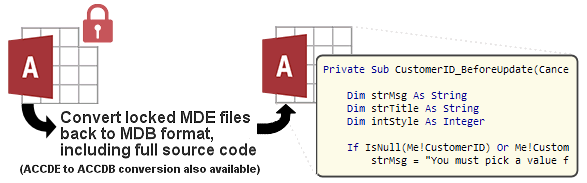
IN THE SPOTLIGHT: MDE to MDB Conversion Service
(also supports: ACCDE to ACCDB, ADE to ADP, etc)
IN THE SPOTLIGHT: Access Database Repair Service
An in-depth repair service for corrupt Microsoft Access files

IN THE SPOTLIGHT: vbWatchdog
VBA error handling just got easier...

" vbWatchdog is off the chart. It solves a long standing problem of how to consolidate error handling into one global location and avoid repetitious code within applications. "
- Joe Anderson,
Microsoft Access MVP
Meet Shady, the vbWatchdog mascot watching over your VBA code →
(courtesy of Crystal Long, Microsoft Access MVP)
IN THE SPOTLIGHT: vbMAPI
An Outlook / MAPI code library for VBA, .NET and C# projects
Get emails out to your customers reliably, and without hassle, every single time.

Use vbMAPI alongside Microsoft Outlook to add professional emailing capabilities to your projects.
IN THE SPOTLIGHT: Code Protector
Standard compilation to MDE/ACCDE format is flawed and reversible.
Provided by Crystal (Microsoft Access MVP), April 2007. Based on code by Allen Browne, adapted from a Usenet posting by Albert Kallal (Microsoft Access MVP.)
The article, List files recursively, explained how to loop through the files in a folder and subfolders, displaying the results in a list box. This alternative writes the files to a table instead of a list box. See the original article for an explanation of the code.
To use this in your database:
To list the files in C:\Data, open the Immediate Window (Ctrl+G), and enter:
Call ListFilesToTable("C:\Data")
To limit the results to zip files:
Call ListFilesToTable("C:\Data", "*.zip")
To include files in subdirectories as well:
Call ListFilesToTable("C:\Data", , True)
Option Compare Database
Option Explicit

'list files to tables
'http://allenbrowne.com/ser-59alt.html

Dim gCount As Long ' added by Crystal

Sub runListFiles()
    'Usage example.
    Dim strPath As String _
    , strFileSpec As String _
    , booIncludeSubfolders As Boolean

    strPath = "E:\"
    strFileSpec = "*.*"
    booIncludeSubfolders = True

    ListFilesToTable strPath, strFileSpec, booIncludeSubfolders
End Sub

'crystal modified parameter specification for strFileSpec by adding default value
Public Function ListFilesToTable(strPath As String _
    , Optional strFileSpec As String = "*.*" _
    , Optional bIncludeSubfolders As Boolean _
    )
On Error GoTo Err_Handler
    'Purpose:   List the files in the path.
    'Arguments: strPath = the path to search.
    '           strFileSpec = "*.*" unless you specify differently.
    '           bIncludeSubfolders: If True, returns results from subdirectories of strPath as well.
    'Method:    FilDir() adds items to a collection, calling itself recursively for subfolders.

    Dim colDirList As New Collection
    Dim varitem As Variant
    Dim rst As DAO.Recordset

   Dim mStartTime As Date _
      , mSeconds As Long _
      , mMin As Long _
      , mMsg As String

   mStartTime = Now()
   '--------

    Call FillDirToTable(colDirList, strPath, strFileSpec, bIncludeSubfolders)

   mSeconds = DateDiff("s", mStartTime, Now())

   mMin = mSeconds \ 60
   If mMin > 0 Then
      mMsg = mMin & " min "
      mSeconds = mSeconds - (mMin * 60)
   Else
      mMsg = ""
   End If

   mMsg = mMsg & mSeconds & " seconds"

   MsgBox "Done adding " & format(gCount, "#,##0") & " files from " & strPath _
      & IIf(Len(Trim(strFileSpec)) > 0, " for file specification --> " & strFileSpec, "") _
      & vbCrLf & vbCrLf & mMsg, , "Done"

Exit_Handler:
   SysCmd acSysCmdClearStatus
   '--------

    Exit Function

Err_Handler:
    MsgBox "Error " & Err.Number & ": " & Err.Description, , "ERROR"

    'remove next line after debugged -- added by Crystal
    Stop: Resume 'added by Crystal

    Resume Exit_Handler
End Function

Private Function FillDirToTable(colDirList As Collection _
    , ByVal strFolder As String _
    , strFileSpec As String _
    , bIncludeSubfolders As Boolean)

    'Build up a list of files, and then add add to this list, any additional folders
    On Error GoTo Err_Handler

    Dim strTemp As String
    Dim colFolders As New Collection
    Dim vFolderName As Variant
    Dim strSQL As String

    'Add the files to the folder.
    strFolder = TrailingSlash(strFolder)
    strTemp = Dir(strFolder & strFileSpec)
    Do While strTemp <> vbNullString
         gCount = gCount + 1
         SysCmd acSysCmdSetStatus, gCount
         strSQL = "INSERT INTO Files " _
          & " (FName, FPath) " _
          & " SELECT """ & strTemp & """" _
          & ", """ & strFolder & """;"
         CurrentDb.Execute strSQL
        colDirList.Add strFolder & strTemp
        strTemp = Dir
    Loop

    If bIncludeSubfolders Then
        'Build collection of additional subfolders.
        strTemp = Dir(strFolder, vbDirectory)
        Do While strTemp <> vbNullString
            If (strTemp <> ".") And (strTemp <> "..") Then
                If (GetAttr(strFolder & strTemp) And vbDirectory) <> 0& Then
                    colFolders.Add strTemp
                End If
            End If
            strTemp = Dir
        Loop
        'Call function recursively for each subfolder.
        For Each vFolderName In colFolders
            Call FillDirToTable(colDirList, strFolder & TrailingSlash(vFolderName), strFileSpec, True)
        Next vFolderName
    End If

Exit_Handler:

    Exit Function

Err_Handler:
    strSQL = "INSERT INTO Files " _
    & " (FName, FPath) " _
    & " SELECT ""  ~~~ ERROR ~~~""" _
    & ", """ & strFolder & """;"
    CurrentDb.Execute strSQL

    Resume Exit_Handler
End Function

Public Function TrailingSlash(varIn As Variant) As String
    If Len(varIn) > 0& Then
        If Right(varIn, 1&) = "\" Then
            TrailingSlash = varIn
        Else
            TrailingSlash = varIn & "\"
        End If
    End If
End Function
| Home | Index of tips | Top |
Rate this article: 
This is a cached tutorial, reproduced with permission.
TWINBASIC LTD (Company No. 16590181, VAT No. GB497509439)
Terms | Privacy | Sitemap | X (Twitter)


