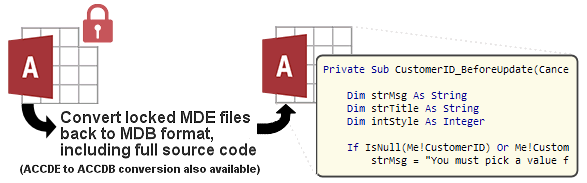
IN THE SPOTLIGHT: MDE to MDB Conversion Service
(also supports: ACCDE to ACCDB, ADE to ADP, etc)
IN THE SPOTLIGHT: Access Database Repair Service
An in-depth repair service for corrupt Microsoft Access files

IN THE SPOTLIGHT: vbWatchdog
VBA error handling just got easier...

" vbWatchdog is off the chart. It solves a long standing problem of how to consolidate error handling into one global location and avoid repetitious code within applications. "
- Joe Anderson,
Microsoft Access MVP
Meet Shady, the vbWatchdog mascot watching over your VBA code →
(courtesy of Crystal Long, Microsoft Access MVP)
IN THE SPOTLIGHT: vbMAPI
An Outlook / MAPI code library for VBA, .NET and C# projects
Get emails out to your customers reliably, and without hassle, every single time.

Use vbMAPI alongside Microsoft Outlook to add professional emailing capabilities to your projects.
IN THE SPOTLIGHT: Code Protector
Standard compilation to MDE/ACCDE format is flawed and reversible.
Here are some details on a selection of 'undocumented' SysCmd functions. You can use these in your Access database applications to do things that generally can't be done easily through the Access Object Model (if at all).
These details are from a number of sources, including my own research. They are likely not 100% accurate and they are definitely not official or supported by Microsoft - use them at your own risk!
| SysCmd(603, strPathInputMdb, strPathOutputMde) - CONVERT MDB TO MDE | |
|
Convert an MDB file into an MDE. Since it takes the source file as a parameter, you cannot convert the database currently open using Access VBA - instead you need to call this from another application/instance:
OR, by using automation (e.g. in VB6): Dim objAccess As Object
'Create the Access Automation object
Set objAccess = CreateObject("Access.Application")
'Now call the undocumented function...
objAccess.SysCmd 602, strPathSourceMdb, strPathDestinationMdb
Set objAccess = Nothing
Note: You need to ensure you are using the correct version of Access to create the MDE (i.e. if it is an Access 2000 MDB file then you can only create an MDE from it by using Access 2000 - not Access 2002/2003). *UPDATE* - It seems that you can use Access XP/2003 to create an Access 2000 MDE file using this method, however be very careful as this is highly likely to fail due to the small differences in compiled VBA code, references and the Access object model etc. My recommendation is to forget that this loop hole exists.
|
|
|
SysCmd(609) - GET PROCESS ID OF CURRENT
INSTANCE - MSACCESS.EXE
- Access 2000+
only
|
|
|
Returns the PID (Process ID) of the currently running MSAccess.exe process. This would come in very handy for some Windows API calls...
|
|
|
SysCmd(504, Flag) - COMPILE VBA MODULES
|
|
|
Where flag can be 16483 to indicate 'Save VBA with compiled code' or 16484 for 'Save VBA without compiled code'. Flag can also be 16481 and 16482 but the functionality is unknown at present.
|
|
|
SysCmd(602, strPathSourceMdb, [strPathDestinationMdb]) -
COMPACT DATABASE
- Access 97 only
|
|
|
Compact (not repair) a database. You cannot compact the *open* database using this method - instead you need to call this from another application/instance: Dim objAccess As Object
'Create the Access Automation object
Set objAccess = CreateObject("Access.Application")
'Now call the undocumented function...
objAccess.SysCmd 602, strPathSourceMdb, strPathDestinationMdb
Set objAccess = Nothing
Note: If you want to compact a file without creating a 'copy' (i.e. compacting the file in place) then simply omit the strPathDestinationMdb parameter.
|
|
|
SysCmd(555) - FORCE CREATION OF MSysIMEXSpecs AND
MSysIMEXColumns
|
|
|
The two tables that are used to store import/export configurations used by Access are not created by default. Calling this function will create them for you.
|
|
|
SysCmd(500) - COUNT OF VBA REFERENCES
- Access 97 only
|
|
|
Return value is the same as Access.References.Count.
|
|
|
SysCmd(501, intReferenceOrdinal) - RAW
STORED STRING OF VBA REFERENCES
- Access 97 only
|
|
|
Where 0 <= intReferenceOrdinal <= SysCmd(500) For each VBA reference, this will return the encoded string which contains all the reference properties (# delimiter) (e.g. GUID#MajorVersion#MinorVersion#LibraryPath#Name) Something like '*\G{00025E01-0000-0000-C000-000000000046}#4.0#0#C:\Program Files\Common Files\Microsoft Shared\DAO\DAO350.DLL#Microsoft DAO 3.51 Object Library'
|
|
|
SysCmd(605, strPathOutput) - CONVERT DATABASE TO ACCESS 97
FORMAT
- Access 2000+
only
|
|
|
Convert the current database to Access 97 format. If strPathOutput = 0 then the output path is requested. In Access 2002/2003 this is the same as Access.ConvertAccessProject strSourcePath, strDestinationPath, acFileFormatAccess97
|
|
|
SysCmd(607,strProjectPath) - CONVERT TO
ADP PROJECT WITHOUT TABLES/QUERIES
-
Access 2000+
only
|
|
|
This command creates a new ADP project and imports the non-Jet components of the currently open database into it (e.g. forms/reports/vba modules). Note: This is not the same as the Upsizing Wizard as it doesn't do anything with the tables or queries.
|
|
| SysCmd(608, intTipID) - VIEW THE OFFICE ASSISTANT TIPS AS STRINGS - Access 2000+ only | |
|
These are the tips used by the Office Assistant, accessible by ordinal number (0-60).
|
|
| SysCmd(710, InputLocaleID) - SET APPLICATION INSTANCE KEYBOARD TYPE | |
|
This call is a wrapper for the Win32 API ActivateKeyboardLayout function. This setting affects the current application instance only and is not saved with the database (you would need to set it within your applications startup routine to make it semi-permanent). The input flag is called the 'input locale identifier' (see API documents for details). Examples of common values (notice the high/low word repeats): InputLocaleID = &H08090809: British InputLocaleID = &H04090409: US English InputLocaleID = &04150415: Polish InputLocaleID = &04190419: Russian InputLocaleID = &H04080408: Greek
|
|
|
SysCmd(711)
- GET APPLICATION INSTANCE
KEYBOARD TYPE
|
|
|
This call is a wrapper for the Win32 API GetKeyboardLayout function. This command returns the applications current InputLocaleID (current instance only) See the flags for previous command (710).
|
|
|
SysCmd(714) - ARE ANY ACCESS OBJECTS IN DESIGN VIEW?
|
|
|
Returns a boolean value (true/false) - True if any form, report, DAP, macro or module is currently open in design mode.
|
|
|
SysCmd(715) - ACCESS BUILD VERSION
|
|
|
Returns the build number of the version of Access that is running. Combine this value with the acSysCmdAccessVer SysCmd constant and you can then determine the service pack, e.g.: SysCmd(acSysCmdAccessVer) = 9 -> Access 2000 SysCmd(715) = 2719 ' Access 2000 No Service Pack SysCmd(715) = 3822 ' Access 2000 SP1 SysCmd(715) = 4506 ' Access 2000 SP2 SysCmd(715) = 6620 ' Access 2000 SP3 SysCmd(acSysCmdAccessVer) = 10 -> Access 2002 SysCmd(715) = 2627 ' Access 2002(XP) No Service Pack SysCmd(715) = 3409 ' Access 2002(XP) SP1 SysCmd(715) = 4302 ' Access 2002(XP) SP2 SysCmd(715) = 6501 ' Access 2002(XP) SP3 SysCmd(acSysCmdAccessVer) = 11 -> Access 2003 SysCmd(715) = 5614 ' Access 2003 No Service Pack SysCmd(715) = 6355 ' Access 2003 SP1 SysCmd(715) = 6566 ' Access 2003 SP2
|
|
|
SysCmd(712) - GET IPictureDisp FROM IMAGE
CONTROL
- Access 2000+ only
|
|
|
Returns a pointer to the IPictureDisp interface behind an image control.
|
|
| If you know of any more, feel free to e-mail them to contact us so we can update the list. |
*Microsoft Access is a trademark of Microsoft Corporation in the United States and other countries*
IMPORTANT: This document may not be reproduced in part or whole without prior consent from the author.
Rate this article: 
Have your say - comment on this article.
What did you think of 'Undocumented SysCmd Functions'?
1. | Paulo Jm says... | 09 Dec 2009 |
Very good | ||
2. | Simon Lampen says... | 22 Dec 2010 |
It appears that converting to ADE or MDE using this method may fail if the source and destination are passed as ref-able variables. To force these variables to be passed byval or to de-reference them, wrap each in a function call such as VBA.Trim(sourcedb) etc. eg: app.SysCmd 603, VBA.Trim(sourceFile_), VBA.Trim(compiledFileName_) This was my experience using Access 2010 on Windows 7. If I passed the variables straight a scambled unicode file name would appear in a parent directory for the destdb and the function would not find the sourcedb if I left the sourcedb using the straight variable. Hope this helps. | ||
3. | Wayne Phillips says... | 23 Dec 2010 |
Thanks for the information, Simon. Someone had reported this to me previously but at the time I was too busy to check it myself. That was several years ago, therefore I assume the issue also affects earlier versions of Access as well. Cheers. | ||
iTech Masters | VAT: GB202994606 | Terms | Sitemap | Newsletter
 Twitter

