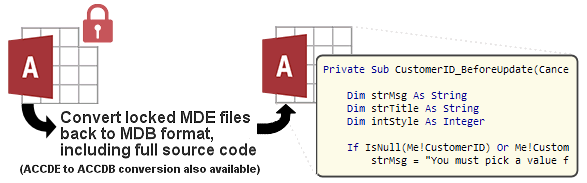
IN THE SPOTLIGHT: MDE to MDB Conversion Service
(also supports: ACCDE to ACCDB, ADE to ADP, etc)
IN THE SPOTLIGHT: Access Database Repair Service
An in-depth repair service for corrupt Microsoft Access files

IN THE SPOTLIGHT: vbWatchdog
VBA error handling just got easier...

" vbWatchdog is off the chart. It solves a long standing problem of how to consolidate error handling into one global location and avoid repetitious code within applications. "
- Joe Anderson,
Microsoft Access MVP
Meet Shady, the vbWatchdog mascot watching over your VBA code →
(courtesy of Crystal Long, Microsoft Access MVP)
IN THE SPOTLIGHT: vbMAPI
An Outlook / MAPI code library for VBA, .NET and C# projects
Get emails out to your customers reliably, and without hassle, every single time.

Use vbMAPI alongside Microsoft Outlook to add professional emailing capabilities to your projects.
IN THE SPOTLIGHT: Code Protector
Standard compilation to MDE/ACCDE format is flawed and reversible.
Provided by Allen Browne, allenbrowne.com
A function can only have one return value. In Access 2, there were a couple of ways to work around this limitation:
Function MultiMode(iMode As Integer) As String
    Select Case iMode
    Case 1
        MultiMode = "Value for first Option"
    Case 2
        MultiMode = "Value for second Option"
    Case Else
        MultiMode = "Error"
    End Select
End FunctionFunction MultiArgu(i1, i2, i3)
i1 = "First Return Value"
i2 = "Second Return Value"
i3 = "Third Return Value"
End FunctionVBA (Access 95 onwards) allows you to return an entire structure of values. In database terms, this is analogous to returning an entire record rather than a single field. For example, imagine an accounting database that needs to summarize income by the categories Wages, Dividends, and Other. VBA allows you to declare a user-defined type to handle this structure:
    Public Type Income
        Wages As Currency
        Dividends As Currency
        Other As Currency
        Total As Currency
    End Type
You can now use this structure as the return type for a function. In a real situation, the function would look up your database tables to get the values, but the return values would be assigned like this:
    Function GetIncome() As Income
        GetIncome.Wages = 950
        GetIncome.Dividends = 570
        GetIncome.Other = 52
        GetIncome.Total = GetIncome.Wages + GetIncome.Dividends + GetIncome.Other
    End Function
To use the function, you could type into the Immediate Window:
GetIncome().Wages
(Note: the use of "Public" in the Type declaration gives it sufficient scope.)
Programmers with a background in C will instantly recognize the possibilities now that user-defined types can be returned from functions. If you're keen, user-defined types can even be based on other user-defined types.
| Home | Index of tips | Top |
Rate this article: 
This is a cached tutorial, reproduced with permission.
iTech Masters | VAT: GB202994606 | Terms | Sitemap | Newsletter
 Twitter

